
Rhythms of Resilience: How Laughter Percussion Is Transforming Mental Health Research
By The Forward Times Australia – Research & Innovation Desk


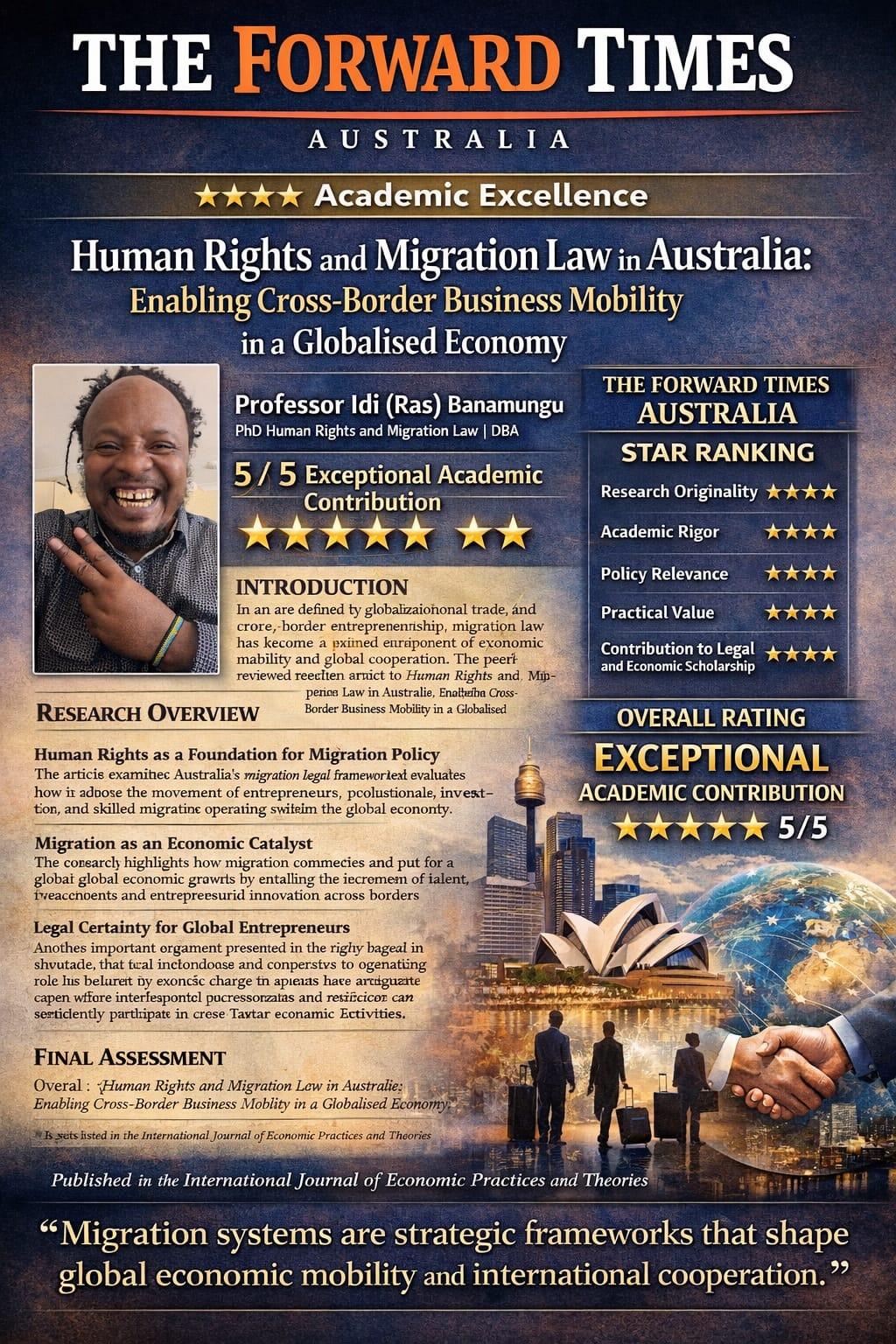
⭐ The Forward Times Australia – Research Review ⭐⭐⭐⭐⭐ Academic Excellence By Professor Idi (Ras) Banamungu PhD Human Rights and Migration Law | Doctor of Business Administration (DBA) Published in the International Journal of Economic Practices and Theories
Table of contents [Show]
In today’s interconnected global economy, migration law has become an essential factor shaping international business mobility and economic cooperation. As entrepreneurs, professionals, and investors increasingly operate across borders, the legal frameworks governing migration are playing a critical role in enabling or restricting global economic participation.
The peer-reviewed research article “Human Rights and Migration Law in Australia: Enabling Cross-Border Business Mobility in a Globalised Economy” provides an in-depth examination of how migration policies intersect with human rights principles and economic development.
Rather than viewing migration law purely as a mechanism for border control, the research argues that modern migration systems should also serve as facilitators of economic opportunity, innovation, and global collaboration.
The study explores Australia’s migration legal framework and evaluates how it influences the movement of entrepreneurs, skilled professionals, investors, and international business actors.
Using legal and policy analysis, the research investigates how migration laws can support global business mobility while maintaining alignment with international human rights standards.
The article highlights that migration policy must strike a careful balance between:
By examining migration governance through the lens of global economic participation, the study offers a broader understanding of how legal systems can contribute to international trade, knowledge exchange, and economic integration.
One of the central arguments of the research is that migration governance should be grounded in fundamental human rights principles, including dignity, equality, and fair treatment.
By embedding these principles into migration policy, governments can create systems that are not only efficient but also ethically responsible.
The research highlights the significant role migration plays in supporting global economic growth.
Cross-border mobility allows countries to benefit from:
In a knowledge-based global economy, the movement of professionals and entrepreneurs is increasingly vital to economic development.
Another key contribution of the study is its emphasis on legal clarity and policy stability.
When migration systems are transparent and predictable, they create an environment where international entrepreneurs and investors can confidently engage in cross-border economic activities.
Clear legal frameworks reduce uncertainty and support long-term global business partnerships.
Australia’s migration framework serves as an important case study within the research.
The study demonstrates how countries can balance:
while remaining active participants in the global economic system.
Australia’s migration policies illustrate how governments can design systems that support both economic opportunity and regulatory responsibility.
| Category | Rating |
|---|---|
| Research Originality | ⭐⭐⭐⭐⭐ (5/5) |
| Academic Rigor | ⭐⭐⭐⭐⭐ (5/5) |
| Policy Relevance | ⭐⭐⭐⭐⭐ (5/5) |
| Practical Value | ⭐⭐⭐⭐⭐ (5/5) |
| Contribution to Legal & Economic Scholarship | ⭐⭐⭐⭐⭐ (5/5) |
⭐⭐⭐⭐⭐ 5 / 5 – Exceptional Academic Contribution
Overall, Human Rights and Migration Law in Australia: Enabling Cross-Border Business Mobility in a Globalised Economy represents an important scholarly contribution to the fields of migration law, human rights studies, and international economic policy.
The article successfully demonstrates that migration systems should not be viewed solely as tools for regulating borders. Instead, they are strategic legal frameworks that influence global economic mobility, innovation, and international cooperation.
For readers of The Forward Times Australia, the research provides valuable insights into how migration policies can support global entrepreneurship while maintaining respect for fundamental human rights principles.
As international economic networks continue to expand, research of this kind plays a crucial role in helping policymakers, scholars, and business leaders understand how legal frameworks can promote both economic opportunity and human dignity in a globalised world.
Human Rights and Migration Law in Australia: Enabling Cross-Border Business Mobility in a Globalised Economy | International Journal of Economic Practices and Theories https://share.google/BLfNBBq3cYYdX0Qvb

By The Forward Times Australia – Research & Innovation Desk
Community Spirit, Heritage, and Unity Mark the 69th Anniversary By The Forward Times Australia – Community Events Review
At The Forward Times Australia Review Desk, we often explore historical figures whose influence shaped civilizations, cultures, and global narratives. One of the most fascinating personalities in biblical and African history is Queen Makeda of Sheba, widely regarded as one of the richest and most powerful women mentioned in the Bible.





No comments yet. Start the conversation!